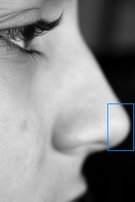
Nose occupies a central location in the face and thus any change in the appearance of the nose becomes immediately apparent. Nose is divided into different parts known as aesthetic subunits. This helps in a better understanding of variations in appearance of the nose and it's management. One of the aesthetic subunits is 'tip' of the nose. Tip occupies the central area of the lower part of the nose. Rhinoplasty is the surgery for improvement of the appearance of the nose and surgery for improvement in the appearance of the tip is known as 'tip-plasty'. Tip-plasty thus forms one of the components of rhinoplasty. Parts of nasal tip The tip of the nose is made up of skin, fatty layer and cartilages. The differences in the shape of individual parts and their inter-relationships determine the appearance of a tip. 1. Skin is the outermost covering. The skin over the tip tends to be thicker than elsewhere in the nose. It is rich in sebum producing glands. 2. Cartilages provide structural support to the tip. They are paired domes attached in the midline with ligaments. The size and shape of the cartilages influence the projection of tip. 3. Fat comprises a layer found between cartilages and skin. Excess of fat leads to a loss of definition of the tip. Variations in appearance of tip These variations of tip are commonly observed: 1. Boxy or bulbous tip: Tip lacks definition in such individuals. 2. Bifid tip: A vertical groove is seen in the midline. 3. Drooping tip: The tip is displaced inferiorly. 4. Dipping of the nasal tip during smiling. Plastic surgery of the tip commonly involves the modification of the underlying cartilages and fatty layer. This is achieved by means of 1. Cartilage trimming: The excess of cartilage is removed thus weakening them. 2. Tip suturing: Different type of sutures modify the shape of the domes of cartilages. These sutures can also help elevate the tip in relation to the septum. 3. Cartilage grafting: Cartilage grafts are used to augment the tips. Grafts can be obtained from within the nose or from elsewhere. Depending upon the need grafts of different shapes are used. 4. Trimming of the fatty layer: An abundance of the fatty layer may lead to a lack of definition of the nasal tip. 5. Modification of the muscles of the upper lip is performed in cases where there is dipping of the tip during animation. It would be uncommon to undertake tip-plasty alone for the improvement of aesthetics of nose. It is usually accompanied by modification to other parts of the nose. Any change brought about to one part of nose tends to have a cascading effect on its neighboring structures. Thus, any surgical plan for improvement of the tip should also take into account the effect on rest of nose as well as the face. A sense of balance and harmony is important when trying to undertake a cosmetic improvement. Rhinoplasty is divided into open and closed rhinoplasty depending upon the incisions. Open rhinoplasty involves placement of incisions on the under-surface of the nose. Most of the incision is hidden. This approach gives a surgeon a good exposure of the operative field and allows direct visualization and modification of the tip structures. Who is a good candidate for tip-plasty? These would include those 1. with reasonable expectation about rhinoplasty or nose job. 2. with good health and do not have any serious co-morbid illness. 3. do not smoke. How does one get a tip-plasty? In case one is bothered about the appearance of the tip it is advisable to discuss it with a friend or partner. This can help you put things in a proper perspective. Preoperative consultation: You can bring along another person during a pre- operative consultation. During an interview with the doctor, you will be asked about your concerns relating to your nose and treatment expectations. You should also come prepared to disclose the history of previous treatments and other medical conditions such as allergy. This helps in making the procedure safer. After clinical examination, the surgeon will be able to suggest treatment options. These differ based on duration, downtime, and outcomes. A consultation is a good time to clarify any doubts. Further tests or investigations may be ordered. In some cases, an ENT consultation may be requested. Images are obtained either in the office or surgical facility. A second consultation may be scheduled in some cases. Anesthesia: Rhinoplasty can be carried out under local anesthesia with or without sedation or general anesthesia. The type of anesthesia is often recommended by the anesthetist. Procedure and recovery: Rhinoplasty is usually carried out as a short stay procedure. Patients can move around as soon as they are awake. Discomfort is usually well controlled with the help of pain medications. Tapes are usually attached to the nose. A drip pad may be taped below the nostrils for the first few days. Patients can usually return home after an overnight stay at the surgical facility. You should arrange for a relative or friend to drive you back to your home. Patients are advised to cleanse the suture lines with a cotton tip applicator during the first week. Swelling is maximal during the second post-operative day. Thereafter it gradually subsides. Sutures are usually removed during the first week. Even though most of the swelling is gone by the end of the first month the nose takes some time to settle into its final shape. Post-operative images are obtained at six months and during subsequent follow-up visits. Risks of tip-plasty: The risks include, 1. Infection. It is uncommon due to the abundant vascularity of nasal tissues. 2. Prominent scarring: It may be seen in some individuals. Only a small part of the scar is visible on undersurface of the nose. Prominent scars usually respond to measures such as the application of silicone tapes and intralesional injections. 3. Unfavorable results: This can sometimes happen. It is important to understand that the final shape of the nose takes nearly one year to become apparent. Revision surgery is carried out after one year. Benefits of tip-plasty: These are, 1. Improved balance and harmony of the nose and facial features. 2. Better self-confidence and esteem. To learn more about nose job (rhinoplasty), click here.
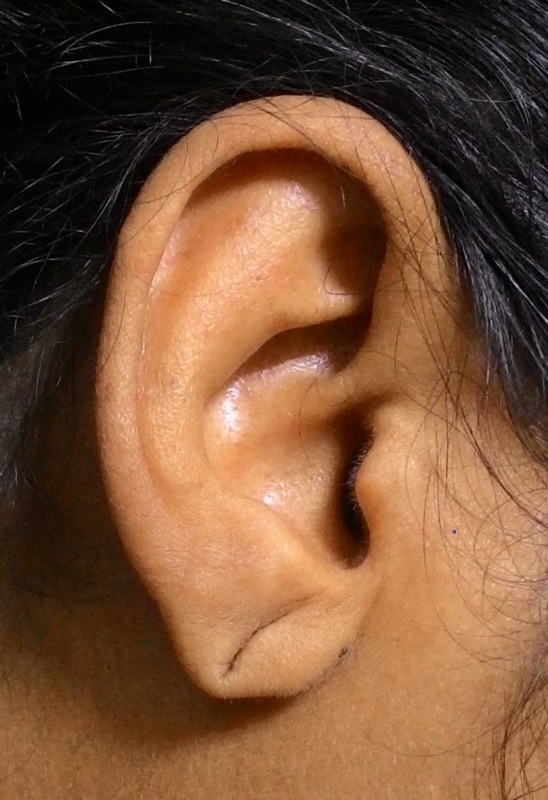
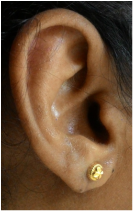
Split earlobe injuries are common. Even more common are the wide apertures which result from wearing heavy earrings for many years. As a result, the ornaments end up dangling instead of lying side by side with the ear lobe skin.
Split earlobes and wide openings can be repaired with a short office procedure. The site is treated with local anesthetic making the procedure painless. The edges of the opening are removed and are then approximated using fine sutures. We modify the technique which enables the local tissue to form a narrowed aperture at the same sitting. This obviates the need for a subsequent piercing of the earlobe. It takes approximately 30 minutes to perform the repair on each side. Patients can return home soon after the procedure. Sutures are removed at 7 days. Light earrings can be worn at the end of 3 weeks. Advantages of Pardue flap technique: 1. There is no need for a subsequent piercing. 2. The original site of the aperture is retained. 3. It is possible to start wearing earrings by the end of 3 weeks. The procedure is safe and does not need any complicated post-operative care. We advise our patients to wear light earrings for a year after the procedure.
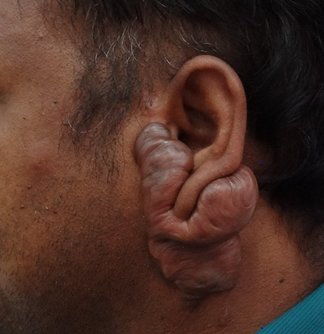
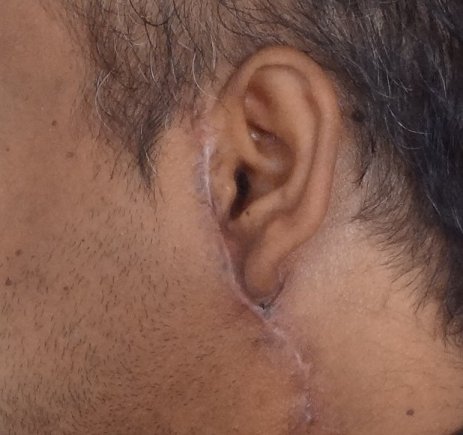
What are keloids?
They are prominent scars which grow beyond the boundaries of the original wound. They can follow trauma, infection, burns or any other type of injury. What are the symptoms of keloids? They are commonly associated with the following, 1. Pain 2. Itching 3. Cosmetic deformity What causes keloids? The exact reasons are not known. It has been found to occur in all types of skin. It is less common among elderly. A tendency for keloid scarring is known to run in families. What are the most common sites of keloids? These include, 1. Ear lobes 2. Chest 3. Back 4. Jawline What are the treatment options for keloids? Large keloids are more difficult to treat when compared to smaller ones. The treatment options include, 1. Intralesional injection of steroids: These have to be repeated at regular intervals for improvement in appearance and texture. 2. Silicone sheet application: Silicone sheets have to be applied for prolonged periods. 3. Pressure garment: These can be applied with the help of a custom made garment. 4. Radiotherapy 5. Intralesional injection of 5 fluorouracil 6. Surgery The combination of more than one modality of treatment is advised in case of large keloids. Surgery is useful for debulking ( reducing the size ) a keloid. It has to be followed up with another modality like intralesional injections or use of pressure garment. What is the role of prevention? The possibility of keloid formation following surgery should be borne in mind in persons with a tendency for keloid formation. Measures such as the use of silicone sheet and pressure garment are advised early in the post operative period. To learn more about other types of scars, click here.
Nose job, otherwise called rhinoplasty is the surgical alteration of the nose. Nose is a midline structure that occupies a central part of the face. Needless to say, it's appearance can be a cause of concern to some. A rhinoplasty is considered to be a demanding surgery where a difference of a few millimeters can bring about a profound change in result. Compared to cosmetic surgery elsewhere it is more difficult to obtain a predictable result with a nose.
So, what is a good nose? There are many proportions which describe what is ideal. But a nose also has to fit the face. A good nose is supposed to be one that does not attract attention to itself. Rather it directs the attention of the beholder to the eyes. What can be achieved with a nose job? It can improve the function and aesthetics of a face. Here the function refers to breathing. The following can be altered, Aesthetics: 1. Height of the bridge ( dorsum ) 2. Width of the bony part ( it can be narrowed ) 3. Width of the base can be narrowed ( base is what is seen when looking from below ) 4. Appearance of the tip ( it can be slightly pushed up, narrowed or made more prominent ) 5. Deviation of the dorsum can be corrected 6. Abnormalities of the nares and ala can be corrected ( nares are the apertures through which air enters inside nose ) Function: Certain causes of obstruction are tackled with a nose job. These include: 1. External valve collapse ( this is seen as collapse of the opening of nose ) 2. Internal valve collapse 3. Septal deviation and turbinate hypertrophy ( these are present inside nose and if these are present they can be addressed along with correction of external nose ) What is a revision rhinoplasty? This is when one rhinoplasty is done to improve upon a previous rhinoplasty. Revision surgeries are more difficult than the primary rhinoplasty. This done when an individual is dissatisfied with his or her previous nose job. To learn more about rhinoplasty (nose job), click here.
Our lips vary in height and volume. Some of us would rather have them to be smaller in size. Lip reduction is a plastic surgery procedure to permanently reduce the size of lips.
Lip reduction may be performed on the upper or lower lips or both. The amount of the reduction is based on patient expectations. Also, the size of lips has to match rest of the facial characteristics like chin and jaw line. In the absence of ideal lip dimensions, the procedure is as much an art as it is about surgical technique. It is a simple office based procedure. It is carried out under local anesthesia. Sometimes it may be combined with sedation to make it more comfortable. After anesthetizing the lips with local anesthetic, a wedge is removed from the inner aspect of lips. The wound is closed using dissolving sutures. The patient can return home the same day after the procedure. Cold compresses and pain medications are prescribed for a few days. It is common to have post-operative swelling of the operated site for a few days. Post-operative discomfort is easily managed with the help of pain medications. Over the subsequent days, the swelling gives way to an improved appearance of lips. In most cases the scar settles very well. In some individuals, there may be an altered sensation of lips which usually settles without any further treatment. 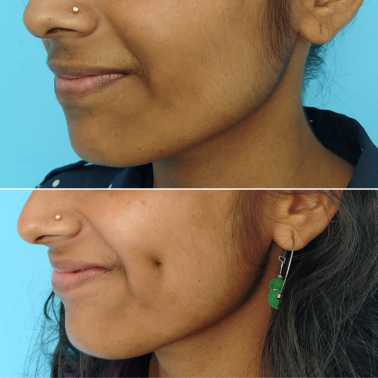
Dimple creation surgery | Before and after
A dimple is considered as cute by many. In some cultures, it is regarded a sign of good luck and prosperity. It results from a difference in the insertion of a cheek muscle into the overlying cheek skin. It can be found on one or both sides of a cheek. In case one does not have a dimple, it is possible to get one with the help of a short plastic surgery procedure. After the small surgery, the individual can soon return home. Creating a dimple begins with a consultation when the patient and doctor together decide on the location of the dimple. Once the position has been marked the doctor anesthetizes the site by injection of a local anesthetic. An incision is placed inside the cheek and a small bit of tissue is removed between the skin and the muscle. A dissolving stitch is used to tether the dermis of the cheek to the underlying muscle. The incision inside the mouth is closed with dissolving stitches. Medications are prescribed for the discomfort which may last for a few days. Antibiotics are advised for five days. Initially, the dimple is seen at rest. As the suture dissolves, the dimple becomes evident only during a smile. During this period scar tissue that forms between the cheek and the muscle is responsible for the dimpling. It is not possible to precisely control the depth of a dimple due to the presence of multiple factors that affect wound healing. In some cases, the dimple may be shallow and can be made deeper with the help of a revision procedure. It is difficult to undo a dimple once it has been created. This should be borne in mind before undertaking the procedure. Yes, it can, when the obstruction is due to structural abnormalities. Nasal obstruction is a common symptom and it can be as a result of : 1. Structural causes 2. Infection 3. Allergies 4. Vasomotor rhinitis Structural abnormalities which lead to nasal obstruction include a deviated nasal septum and associated hypertrophy of turbinates, growths and collapse of the internal and external nasal valves. The cause of nasal obstruction is determined after history taking, clinical examination and investigations like endoscopy. Treatment is based on the cause and it is usually possible to alter the abnormal anatomy to improve air flow. The deviated septum can be re-positioned in the midline. In adults often a part of the septum is removed when it is referred to as septoplasty. Hypertrophy of turbinates (shelf-like protrusions from the sidewalls ) is treated by conservative reduction. Sometimes the abnormal air flow patterns can be as a result of a collapse of internal and external nasal valves. This can be as a result of trauma or surgery. The collapse of the valves is usually managed with cartilage grafts. Addressing the abnormality of the obstruction as well as preventing them becomes an important part of a rhinoplasty. Rhinoplasty is one area of plastic surgery where both appearance and function are equally important and inseparable. To learn more about rhinoplasty, click here. 
Blepharoplasty is the surgery of the eyelids. Depending on which lid is being treated it is referred to as upper or lower lid blepharoplasty. It is one of the more commonly performed cosmetic procedures of the face.
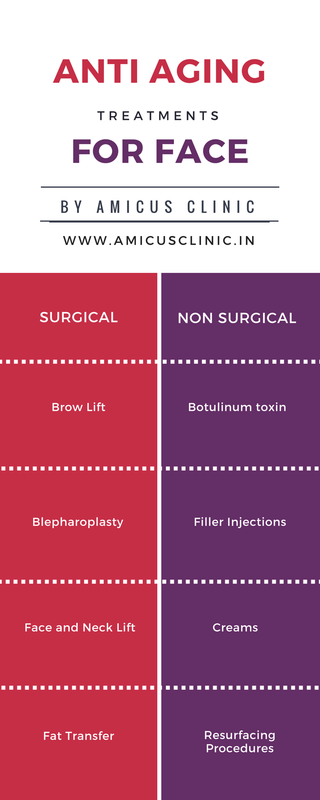
Our eyes are considered to be the most important aesthetic units of our face. They are considered as windows to our soul probably because they easily reflect our level of alertness, mood, and sense of well-being. The eyes are also subject to early signs of aging. These changes reveal as extra folds of skin in the upper lid which in some advanced cases can hamper our visual fields. This may be accompanied by loss of definition of the area immediately below eyebrows. The lateral corners of eyes may shift downwards giving rise to a tired appearance. Lower lid undergoes changes as a result of the loss of support of eyelid tissues. They may shift downwards with more display of the white below cornea. There may be baggy swellings of lower lid as a result of protrusion of fat around the eyes. The lower eyelid appears lengthened with an abrupt demarcation between lower lid and cheek. The youthful 'blending' of lower lid and cheek is lost with age. Blepharoplasty benefits those with aging changes of the eyelids. It is also undertaken for those who need an alteration of their prominent epicanthal folds. It can also be undertaken for individuals who desire an extra fold in the upper lid. Evaluation for blepharoplasty begins with a preoperative consultation when a patient indicates her concerns to the physician. Patients should come prepared to reveal details of the previous treatment of the eyes (for example, LASIK, use of contact lens) and systemic illnesses. The physician suggests treatment options based on changes present in the eyelids and neighboring structures. A consultation with an ophthalmologist is also arranged. The patient is advised to stop all forms of herbal supplements and blood thinners for two weeks before the scheduled procedure. Isolated blepharoplasty of the upper lid is usually carried out under local anesthesia with sedation. More extensive procedures involving the lower lid may necessitate general anesthesia for the comfort of the patient. The choice of anesthesia is decided in consultation with the anesthetist. Patient recovery is usually rapid and she can return home the same day or the next. Sutures are pulled out by the end of the first week. Swelling starts to subside after the first 36 hours. If the surgery involved a number of steps, the swelling may take longer to subside. Patients are usually presentable at the end of second to the third week. When properly executed, blepharoplasty is one of the most gratifying procedures in cosmetic surgery. It gives rise to alert and youthful looking eyes. To learn more about other facial plastic surgery procedures, click here. |
AuthorI like to keep it simple. CategoriesArchives
March 2024
Categories |
- Home
-
Cosmetic
- Fat grafting
- Swellings and moles
- Scar revision
- Leukoderma (Melanocyte transfer)
- Hair transplant
- Facial rejuvenation procedures
- Nose job (Rhinoplasty)
- Cleft lip nose correction
- Ear (Otoplasty)
- Lip reduction
- Breast augmentation
- Breast reduction
- Tuberous breasts
- Axillary breasts
- Gynecomastia
- Liposuction
- Brachioplasty (Arm contouring)
- Abdominoplasty (Tummy tuck)
- Female genital rejuvenation
-
Reconstructive
- Contact
- Blog
- Home
-
Cosmetic
- Fat grafting
- Swellings and moles
- Scar revision
- Leukoderma (Melanocyte transfer)
- Hair transplant
- Facial rejuvenation procedures
- Nose job (Rhinoplasty)
- Cleft lip nose correction
- Ear (Otoplasty)
- Lip reduction
- Breast augmentation
- Breast reduction
- Tuberous breasts
- Axillary breasts
- Gynecomastia
- Liposuction
- Brachioplasty (Arm contouring)
- Abdominoplasty (Tummy tuck)
- Female genital rejuvenation
-
Reconstructive
- Contact
- Blog
 RSS Feed
You can leave us a comment using the contact form below.
We shall get back to you at the earliest.
We shall get back to you at the earliest.
International Society of Aesthetic Plastic Surgery
|
Indian Association of Aesthetic Plastic Surgeons Membership Logo
|
Rhinoplasty Society of India
|
ISAPS Patient Safety Diamond
|
Links
- Face procedures | Rhinoplasty, Otoplasty, Lip reduction, Fat grafting
- Body procedures | Gynecomastia , Breast reduction, Abdominoplasty, Brachioplasty, Liposuction
- Skin procedures | Scar revision, Moles, Leukoderma surgery
Let's be friends !
Follow us at Facebook and Twitter.
Follow us at Facebook and Twitter.
Vectors designed by Freepik
© 2024 Amicus Clinic (Plastic Surgery Centre, Trivandrum). All rights reserved.
© 2024 Amicus Clinic (Plastic Surgery Centre, Trivandrum). All rights reserved.